Why Earn a Joint PharmD/MS in Pharmaceutical Sciences?
Accelerate your career with the Joint PharmD/MS in Pharmaceutical Sciences (MSPS) at Pacific University School of Pharmacy!
This streamlined, integrated pathway empowers you to earn two prestigious degrees simultaneously, saving you time while maximizing your impact. By merging professional clinical training with high-level scientific research, you’ll gain a distinct competitive edge for leadership roles in industry, academia, and clinical research.
Through this program, students gain a deep understanding of drug discovery, pharmacokinetics, pharmacology, toxicology, and related disciplines while developing critical laboratory and analytical skills. Graduates emerge with the scientific, clinical, and communication competencies needed to lead innovation in patient-centered pharmaceutical care and research.
Program Highlights
Students in the PharmD/MSPS joint pathway complete both degrees within an accelerated timeframe by integrating research coursework and thesis work during their PharmD studies.
- Integrated Curriculum: Coursework combines PharmD foundational and clinical education with advanced MSPS scientific training.
- Research-Intensive Learning: Over 55% of MSPS coursework (31 credits) focuses on laboratory-based research.
- Mentored Thesis Project: Students work closely with faculty mentors on independent, hypothesis-driven research projects culminating in a written thesis and defense.
- Collaborative Learning: More than 80% of didactic coursework is completed alongside first-year PharmD students, fostering interprofessional collaboration and shared learning.
What Can You do With a Joint PharmD/MS in Pharmaceutical Sciences?
Graduates of the joint PharmD/MSPS program are uniquely positioned for:
- Advanced roles in pharmaceutical, biotechnology, and biomedical industries
- Research and development positions in academic or governmental laboratories
- Pursuing advanced training, including PhD programs or postdoctoral research
- Competitive clinical or regulatory rolesthat require both clinical and scientific expertise
Curriculum Design
Program Structure and Duration
Students enrolled in the 3-year PharmD pathway can complete both degrees within 4 years. These students complete their PharmD curriculum over the standard three years while simultaneously working on their MSPS coursework. At the end of the third year, they graduate with the Doctor of Pharmacy (PharmD) degree. During the additional fourth year, they focus exclusively on completing their master’s thesis research and remaining MSPS degree requirements, culminating in graduation with the Master of Science (MS) degree.
Students enrolled in the 5-year PharmD pathway can complete both degrees within 5 years. In this track, students complete the requirements for the MSPS degree during their first four years and graduate with the Master of Science (MS) degree. They then focus on the final year of their PharmD program and, at the end of the fifth year, receive the Doctor of Pharmacy (PharmD) degree.
Approximate Credit Overview
- Total: 56.5 credits (combined across didactic, research, and thesis components)
- Shared Coursework: 26.5 credits overlapping with the PharmD curriculum
- MSPS-Specific Courses: 5 credits (Scientific Communication, Advanced Topics, and Research Seminar Series)
- Research & Thesis: 31 credits dedicated to research training and laboratory work
Exciting Research Opportunities
Our Pharmaceutical Sciences faculty lead NIH-funded and cutting-edge research in areas including:
- Drug Discovery
- Drug Metabolism
- Infectious Diseases
- Pharmacokinetics
- Pharmacology
- Medicinal Chemistry
- Natural Products
- Oncology
- Toxicology
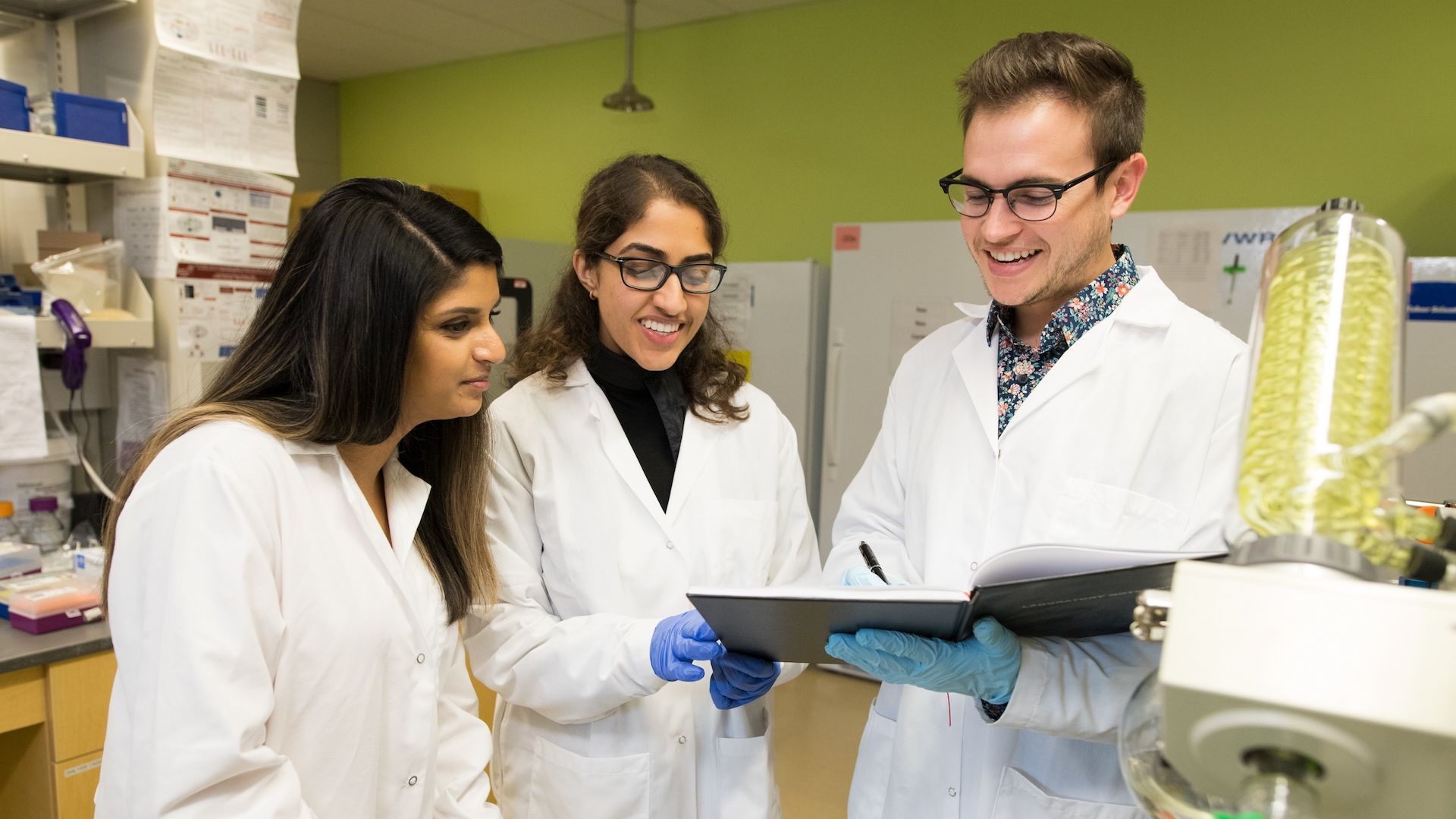
Modern Science Research Laboratory
The open-layout, state-of-the-art research laboratory promotes an environment for collaboration and interaction.
It is equipped to meet different research demands and to train skills for in silico, in vitro, and in vivo studies conducted across industrial or academic institutions:
- High-performance liquid chromatography (HPLC)
- Microscopy
- Liquid chromatography–mass spectrometry (LC–MS)
- Western blotting
- Molecular biology techniques
- Cell culture techniques
- Peptide synthesis
- Flow cytometry
- Quantitative polymerase chain reaction (qPCR)
Admissions and Eligibility
Students currently enrolled in the PharmD program at Pacific University are eligible to apply for the joint PharmD/MSPS pathway after completing the first academic year.
Applicants must be in good academic standing and demonstrate strong interest in research.