Banner Image
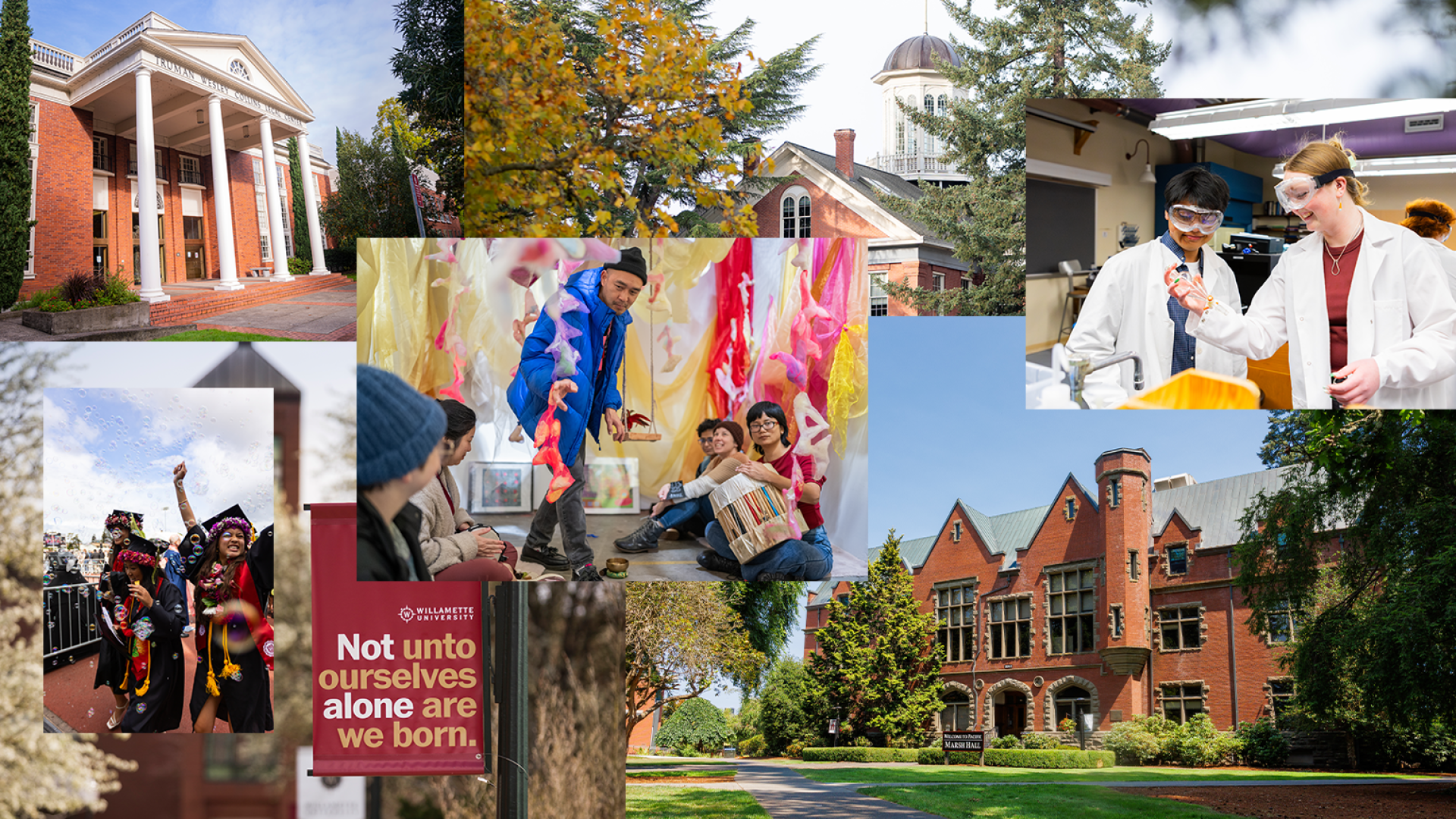
A college of images of students and locations at Pacific University and Willamette University

Better Together

Paragraphs

Pacific University and Willamette University have agreed to merge to create the largest private university in Oregon

The two oldest universities in the West have signed an agreement to unite to form the largest private university in Oregon. With more than 6,000 students and a comprehensive portfolio of academic programs spanning the liberal arts and sciences, law, business, health professions and optometry, education, arts, design, and computing and data science, the combined university intends to expand academic opportunities, career pathways, and service to the region.

Shared Mission & History

Willamette, founded in 1842, and Pacific, founded in 1849, were the first universities in the western United States. Both rooted in a commitment to serving the public good through education, the two universities have — for nearly two centuries — championed the role of private universities in serving the needs of their communities.

Each centered on a foundation in the liberal arts and sciences, Willamette and Pacific have developed distinct strengths in different arenas while expanding educational and career opportunities for their students. Pacific launched the state’s first degree programs in teaching, optometry, occupational therapy, physical therapy, and dental therapy, and today is the No. 1 private educator of healthcare professionals in Oregon. Willamette launched the state’s first medical school and law school, and produced generations of leaders and changemakers who have shaped the region’s civic, legal, and cultural fabric. 

Expanded Academic Pathways

By joining forces, Willamette and Pacific will be poised to expand opportunities for students and alumni.  In the future, the combined university can offer broader academic pathways, student services, and career networks. Our vision for the future includes:

  • Direct pathways between the universities’ undergraduate and graduate programs
  • “Study away” opportunities for students at Willamette, Pacific, or the Pacific Northwest College of Art (PNCA merged with Willamette in 2021)
  • Access to research opportunities or faculty expertise across campuses
  • New academic programs to meet the changing student and workforce demands of the future

Building the New American Collegiate University

The combined university will adopt a collegiate model rare in American higher education. Under this structure, each school or college of the merged university is expected to retain its name, campus, admissions process, traditions, clubs and athletic programs — and the unique identities that are central to student and alumni belonging and pride. 

Each school or college benefits from the scale, strength, and breadth of a larger institution without losing the close-knit communities and sense of belonging that generations of students have enjoyed and valued.

Regional Leadership

As higher education faces significant headwinds, Willamette and Pacific are coming together to expand what can be offered under one university and intend to do more with more by leveraging our complementary programs and strengths. 

The merger of equals is expected to position the historic institutions to continue their legacy of service with a greater capacity to grow and serve the emerging needs of the state and the region through meaningful undergraduate and graduate education, workforce development, and leadership in the region’s civic, legal and cultural arenas.

  1. Pacific & Willamette boards sign letter of intent to merge

  2. Pacific & Willamette governing boards vote unanimous approval to move forward

  3. Pacific & Willamette boards sign plan of merger

  4. Implementation teams begin plans for integration of university systems

  5. After the first stage of regulatory approvals, Willamette and Pacific complete the corporate merger, becoming a single nonprofit entity.

  6. After additional required regulatory approvals, Willamette and Pacific will merge into a single higher education institution.

Frequently Asked Questions

General Questions

  • What is happening between Willamette and Pacific?
    • Willamette University and Pacific University have agreed to come together to create the largest and most comprehensive private university in Oregon. 
    • Each school and college of Willamette and Pacific is expected to retain its name, identity, campuses, traditions, clubs and athletic programs, and admissions processes. 
    • But upon completion of the merger process they also will be part of something bigger: a comprehensive university spanning the liberal arts and sciences, law, business, health professions and optometry, education, arts, design, and computing and data science. Serving 6,000 students and connecting an alumni network of more than 73,000 leaders and changemakers, the combined university will leverage the strengths of Pacific and Willamette to expand student opportunities and tackle the unique challenges facing our region.
  • Why are Willamette and Pacific merging?
    • The oldest institutions of higher education in the West, Willamette and Pacific are united by shared values and core missions that are focused on changing lives through education and preparing students to make a difference in the world. This merger puts that commitment into action in a bigger, bolder way for the future, creating more choices and expanding opportunities and resources for students. 
    • Students and families have told us they are looking for an education that delivers clear value and connections to careers. By agreeing to combine and create a larger university, we can invest more strategically in the programs, technologies, and partnerships that directly benefit students and direct resources toward what matters most. The future combined university is expected to offer students more impactful opportunities and more support while preserving the distinctive, personalized, close-knit education that makes each university community so special. 
  • What is a collegiate university? How is this different from a consortium?
    • A collegiate university is one university made up of several distinct colleges that each maintain a unique identity, name, culture, admissions standards, traditions, and sense of community, while being part of a unified institution of higher education. Think of it as a family living under the same roof, where each member has their own room filled with their personality, style and preferences. They are distinct but unified under one household.
    • In a consortium, the member colleges are separate, independent institutions. Each school has its own budget, board, and is accredited individually. Essentially, they are neighbors who choose to share some amenities, like a library system or shuttle system.
    • We are choosing a collegiate university structure in order to maintain the best of our existing schools and colleges while reaping the benefits of a larger university.
  • How does this process work?
    • Right now, Willamette and Pacific continue to operate as separate legal entities, as we complete the first stage of regulatory approvals, which is expected by early 2027. At that time, there will be a “corporate merger” of the existing nonprofit operating entities into a single legal entity. 
    • After the corporate merger is a transition period. Willamette and Pacific will be part of one corporate entity, governed by a single board of trustees. But they will remain separate universities with separate academic programs, degree authorization, accreditation, and federal financial aid participation. During this transition period, the universities will be working toward additional regulatory approvals and planning for future integration.
    • Upon final regulatory approvals, potentially in 2028, the institutions would merge into a single combined university.
    • Willamette President Steve Thorsett and Pacific President Jenny Coyle will jointly lead the combined university. As chancellor, Thorsett will oversee business operations, and as president, Coyle will oversee academics and student affairs. The combined institution will be governed by a single, shared board of trustees.
  • Is this merger being driven by financial reasons?
    • Across higher education, many mergers are driven by financial distress. What Pacific and Willamette are doing is different. We’re not merging because we have to; we’re doing it because we choose to. Both universities are operating on balanced budgets, and both institutions are stable on their own. 
    • We’re taking this bold step from positions of strength to pursue a vision to expand student opportunities and to better meet the workforce needs of the region. At a time when universities across the country are being forced to cut back, we’re seeking to grow together.
  • What will the combined university be named?
    • During the transitional period, both institutions will continue to operate under their existing names.  We are using the provisional name, University of the Northwest, to reflect the scope, scale, and regional impact of the combined institution. We know that the name matters, and we’re committed to selecting one that honors the legacies of the two institutions while embracing our shared future.
       

For Alumni & Donors

  • Is Pacific or Willamette going away?
    • The collegiate model we are pursuing explicitly initially preserves the identities, names, campuses, and admissions processes for each school or college. 
  • What does this mean for my degree?
    • Your degree does not change. You still hold a degree from [Pacific/Willamette], and it still represents your achievements, experiences, and qualifications. 
  • How will the merger honor the history and traditions of [Pacific or Willamette]?
    • We understand how deeply our community cares about Pacific’s history and cherished traditions. Preserving what makes Pacific special is a top priority throughout this merger process. From Lū‘au and Boxer to preserving our liberal arts tradition and public service through education and healthcare, we continue to treasure and advance our mission to inspire students who think, care, create, and pursue justice in the world. We will continue to provide the close, nurturing learning environment that has served our students for nearly two centuries, and we remain committed to our goal of becoming an Opportunity University, transforming potential into purpose through access.
    • At the same time, this merger presents an opportunity to build new traditions that reflect our combined strengths and shared values. The blending of two institutions with their own rich histories opens the door to celebrate and learn from one another. This merger is about enhancing and advancing Pacific’s mission and its future.
  • How will endowments be affected? What happens with the gifts I’ve already made?
    • The endowed funds established to support students, programs, and schools at Willamette, Pacific, and PNCA will continue to be individually tracked and used in accordance with the intent of their donors. It will still be possible to add to existing endowments, or to establish new endowments in support of programs at any individual campus. The merger also presents opportunities to make new gifts in support of the bold vision and goals of the united university, such as cross-campus programs or to support students or faculty across the entire university.
  • This is exciting! How can I get involved and help?
    • We are thrilled that you are excited! We hope you will join opportunities to learn more in the coming weeks and months. Encourage your classmates and friends to get involved as well. Spread the news — share stories to your social media and serve as an ambassador in your community. Let us know you’d like to get involved at alumni@pacificu.edu. Your philanthropic support makes an incredible difference for today’s students and future generations. When you receive requests to support the Boxer Spirit Fund, we hope you will make a meaningful gift. If you’d like to consider a larger gift or include us in your estate plans, let us know at give@pacificu.edu.
       

For Faculty & Staff

  • What does this mean for me?
    • For the most part, faculty and staff will not see immediate changes. As we prepare for the corporate merger and then move into the transition phase, we will be focused on aligning operations and systems, such as payroll and budgeting, as well as planning new opportunities for students, such as new academic programs or pathways. 
    • The goal of the merger is to do “more with more” — whether that’s enhancing student support services, expanding academic programs, strengthening research capabilities, or improving operational effectiveness. 
    • Faculty and staff will be critical partners in developing and implementing these opportunities.
  • Will my employee benefits change?
    • We are in the process of evaluating all aspects of the transition, and employee benefits are an important part of that review. No decisions have been made at this time. Any future changes to benefits will be communicated in advance to give you time to understand what they mean for you and your family.
  • Will staff be expected to work on different campuses?
    • Work is still underway to determine the complete organizational structure through and following the merger milestones. At this time, we expect that most staff will remain based at their current campuses. Some roles may involve travel to other campuses depending on the nature of the position and departmental needs. 
  • How will faculty and staff be engaged in conversation before future decisions are made?
    • We will be actively engaging with faculty and staff for input on academic and co-curricular programs, governance, expanding opportunities for student services, teaching, and research — the decisions that will shape the future combined institution.
  • I am a faculty member. How will my appointment change in the combined university?
    • Your appointment won't change this academic year (2026-2027) because of the merger. Your home base will be in a college or school, but there may be opportunities to teach across different areas — similar to what some faculty already do. For example, you might be based in a graduate program but teach undergraduates, or vice versa.
  • Will there be opportunities to teach on another campus? How will it be decided who teaches where?
    • We expect this collaboration will expand opportunities for teaching across the combined institution in the future. Depending on your expertise and the needs of our students and programs, there may be opportunities to teach on another campus and for different students (graduate and undergraduate). This decision will be made through collaboration across the schools and colleges and in consultation with the faculty.
  • Will there be separate faculty handbooks or will we move to one handbook?
    • Right now, there are multiple faculty between the institutions. As a combined university, we will want to ensure equitable conditions for all faculty. We will work with faculty to determine what a consistent and equitable governance structure will look like.
  • How will the combined institution impact my research? Will it create new resources?
    • We are not asking you to change how or why you do research and/or professional development because of the merger. We expect to continue to support your professional development in ways we have in the past. The goal of this merger is to increase resources and collaborative opportunities across the combined university. 
    • As one example, in the future, there may be opportunities to share facilities, research equipment, and even expertise as we come together. 
    • We hope to align and amplify grant support, which should support research and resource acquisition.
  • Will we compete for students?
    • Historically, relatively few students apply to both Willamette (including PNCA) and Pacific. Each undergraduate college is expected to retain its distinct strengths, unique identity and sports teams, so in future years, we anticipate the programs at each being complementary rather than competitive.
  • How can I help/be involved?
    • You are an essential part of this vision. As faculty and staff, you are the heart of the Pacific experience and will turn this bigger, bolder future into reality. We are committed to keeping you informed about the merger as we have more details to share. University leadership and the merger team will hold community town hall meetings throughout this process to provide updates and answer your questions. 
    • Merger updates will continue to be shared with the community via email, community town hall meetings, and on the merger information page.
    • This merger information page will be updated as new details emerge and decisions are made. Check the site and FAQ for the most up to date information.
  • Will there be a new website?
    • It is likely that the combined institution will have an updated website, but for now, Willamette and Pacific as separate universities will continue to have separate websites. 
  • What should I tell family and friends who ask me about the merger? 
    • We know that there is a lot of curiosity about what the merger will look like. At this stage, we have a vision of where we want to end up but the details of how that will happen are part of the work ahead of us. You are an important piece in that work. For now, we want to spread the word that the merger is about creating more opportunity for students in the Northwest. We are two stable institutions with complementary programs joining forces so that we can provide students with more opportunity while retaining the small campus community and liberal arts ethos that are core to the Willamette and Pacific experience. 
       

For Current Students

  • I am a current student at Pacific. What does this mean for me?
    • Your education and experience is expected to continue uninterrupted. The merger will not affect your tuition, financial aid, and academic standing.
    • As the integration progresses, the intent is for students to be able to gain access to new opportunities, such as:
    • Accelerated degree pathways that can help you complete advanced credentials more efficiently
      • Expanded dual-degree programs across a broader range of fields
      • Enhanced career services and related resources
      • Increased course offerings and academic resources
      • An expanded alumni and career network, with leaders across the region and around the world
  • How will this merger affect tuition and financial aid?
    • In the immediate future, there will be no change to tuition and financial aid because of the merger. Until Pacific and Willamette are fully combined into a single university, which is not expected to occur until at least 2028, they will continue to maintain independent tuition, fees and financial aid structures. After that point, any anticipated changes will be shared with students early to ensure the transition is as seamless as possible.
    • Both Pacific and Willamette offer generous aid packages that increase access to higher education, and that will not change with this partnership. We are committed to honoring all existing scholarships and institutional financial aid awards.
  • Will my scholarships continue to be honored?
    • Any existing multi-year scholarships will be honored and will remain unchanged for the duration of the scholarship.
  • What about my degree/diploma? Will that change?
    • Willamette and Pacific will remain separately accredited degree-granting institutions through the transition period and will continue to issue their own degrees and diplomas.
    • After Willamette and Pacific are combined into a single university, degrees will continue to include the school or college you attended and will be issued by the combined university. 
  • Can I take undergraduate classes across different campuses or universities?
    • At this point, no. Each undergraduate college has its own admission process, so you are a student only at the college where you are enrolled. 
    • Over time, new opportunities may be developed to create academic pathways across colleges or programs.
  • I am a student-athlete. Are athletics programs going to change? Can I switch teams? Play some sports on my current campus and other sports on another campus?
    • The Willamette and Pacific intend for Bearcat and Boxer athletics to remain the same. Pacific and Willamette have a century-long competitive legacy, and an academic partnership will only intensify those collegial rivalries. The legacy Pacific and Willamette campuses of the combined university expect to continue to compete separately in the Northwest Conference of the NCAA Division III. 
    • Although Pacific and Willamette will become a single university for all other purposes, we understand the NCAA will permit a student-athlete to be affiliated with only a single campus and the athletic programs at that campus. A move from Bearcat to Boxer athletics, or vice versa, would be considered a transfer under NCAA rules and be subject to NCAA policies on transfers.
  • When will I be able to take advantage of the new opportunities this merger will create for students?
    • Meaningful changes resulting from the merger will take time and are dependent on the approvals of multiple higher education regulatory authorities.
    • Based on the anticipated timeframe, if you're a current student graduating before 2027, you may see limited direct impacts before graduation. Your benefits from the merger are expected to come later, as a member of a broader alumni and employer network. If you're an incoming or early-year student, you may experience benefits from the merger process as you progress through your degree. We're committed to doing this thoughtfully so that when opportunities do become available, they're meaningful and well-executed.  

For Prospective Students & Families

  • Is Pacific at risk of closing?
    • No. Across higher education, many mergers are driven by financial distress. What Pacific and Willamette are doing is different. We’re not merging because we have to; we’re doing it because we choose to. Both universities are operating on balanced budgets, and both institutions are stable on their own. 
    • We’re taking this bold step from positions of strength to pursue a vision to expand opportunities for you and to better meet the workforce news of the region. At a time when universities across the country are being forced to cut back, we’re seeking to grow together.
  • I’m considering applying to Pacific. Does this change how I apply?
    • No. Even after Pacific and Willamette fully combine into a single university, each of the schools and colleges will continue to set their own admissions standards and make their own admissions and financial aid decisions.

Related News

Summary
If approved, this historic combination, provisionally the University of the Northwest, would work to create more pathways for students, more avenues for collaboration, and more opportunities for Oregon and the West in an institution that would combine the flexibility and nimbleness of a small school with the breadth and resources of a larger institution.

Media Mentions

Summary
July 14, 2026 | The Oregonian tells readers that Pacific President Jenny Coyle and Willamette President Steve Thorsett "hope the combined universities will open up access to a great alumni network and more career pathways for current students, particularly in healthcare, law and education."
Summary
July 14, 2026 | "Research on college merger has shown that strategic consolidation can lead to institutional growth, cost savings and improved success. But higher ed experts warn that a successful merger comes long before either institution is in a financial crisis. Willamette and Pacific appear to be heeding that advice," says OPB in its coverage of the Pacific/Willamette merger.
Summary
July 14, 2026 | Pacific President Jenny Coyle and Willamette President Steve Thorsett explain the upcoming merger of their two schools to KOBI-TV in Medford, Oregon. "I think one of the great things that makes us such compatible institutions is that we are both adventurous, creative, and adaptive institutions," Thorsett said.