
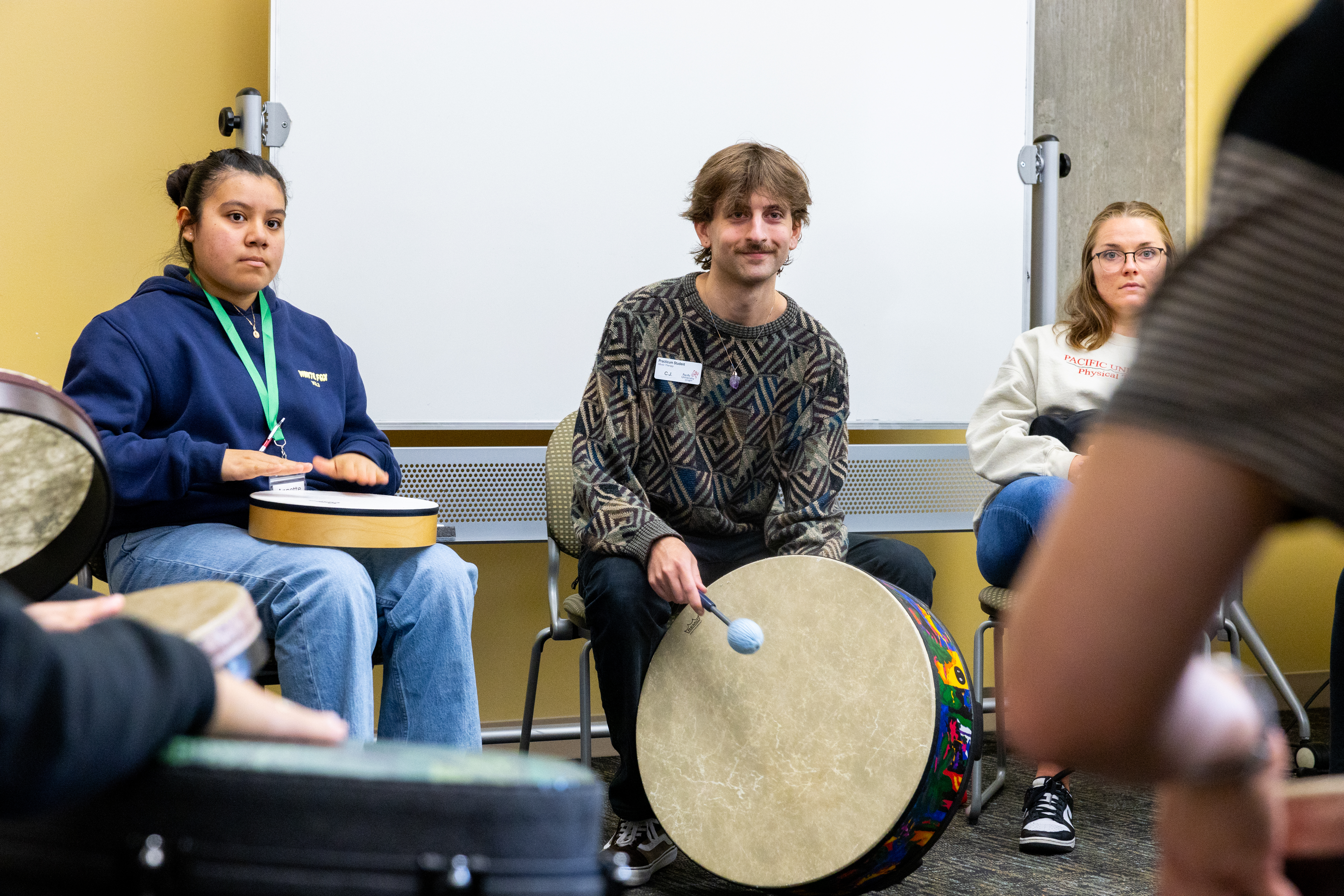
What is Music Therapy and What Does a Music Therapist Do?
Are you a musician planning for college? Apply for a Music Scholarship at Pacific University. These scholarships are available across majors to support your musical and academic development.
Are you looking for a degree program that combines your love of music with your passion for helping people? While many musicians pursue a music education degree, a music therapy degree is another option that also prepares you to serve your community. Music therapy is a creative and purpose-driven field that sets you up for a flexible and growing career. A degree in music therapy supports your development as a musician through rigorous training while also giving you the skills you need to work in therapeutic settings.
What is music therapy?
Music therapy is a research-informed clinical practice in which credentialed professionals use music-based interventions to address physical, emotional, cognitive and social needs. Using singing, instruments, songwriting, movement and receptive listening, music therapists assess a patient’s strengths and goals, and then design sessions that support improvement and healing. The process is collaborative, person-centered and grounded in evidence.
How does music therapy work?
Music has a documented therapeutic impact. It can reduce stress and anxiety, support motor recovery and coordination, enhance communication, and improve mood and social engagement. Rhythm can cue movement. Melody can stimulate memory recall. Structured improvisation can facilitate self-expression. Delivered by trained professionals, music becomes a flexible, accessible modality that complements medical care, behavioral health services and educational supports. Music therapy works by leveraging musical elements to achieve measurable clinical goals.
What does a music therapist do?
Music therapists use their musicianship and musical knowledge in therapeutic settings. They serve people of all ages and in a variety of circumstances. Clients may include every age group from children to older adults. Music therapists might help people navigate developmental differences, mental health challenges, recovery from stroke or traumatic brain injury, pain and anxiety management, and living with dementia and other illnesses. Music therapists may work with groups or individuals, through a larger organization or in private practice.
Music therapists also continue to practice their own musical skills through musical performance, playing in ensembles, writing music, and other creative endeavors. Continuing to develop their musicianship and artistry helps music therapists to maintain and grow the love of music that set them on their career paths and bring this passion for music to the people with whom they work.
Where do music therapists work?
Practicing music therapists work in hospitals and outpatient clinics, rehabilitation centers, skilled nursing and memory care facilities, schools and early intervention programs, behavioral health and substance use treatment centers, veteran’s centers, hospice and palliative care, community agencies, and private practice. While working with a program, facility, or company provides opportunities for teamwork and organizational support, setting up a private practice allows the freedom to set your own work location and hours.
How do I become a music therapist?
To become a music therapist you need a music therapy degree and licensure. Becoming a music therapist begins with formal music therapy education in an accredited program that integrates music, psychology, and clinical practice. Most practitioners enter the profession by completing a bachelor’s music therapy degree from a program approved by the American Music Therapy Association (AMTA), including a six month internship, and take the CBMT board-certification exam to attain licensure.
Degree programs emphasize musicianship alongside clinical foundations. Typical coursework includes music theory, ear training, voice and instrumental techniques, improvisation, composition, and music technology, paired with anatomy, physiology, psychology, counseling, research methods and ethics. Students learn assessment, treatment planning, and documentation consistent with professional standards.
How do I choose a music therapy program?
When evaluating programs, consider the following:
- AMTA approval status
- Faculty expertise and mentorship
- The variety and quality of clinical placements
- Preparation for the national board certification exam
- Access to ensembles, practice rooms and adaptive instruments
- Opportunities for research or interprofessional collaboration
- the program's philosophical approach (such as neuroscience, psychodynamic principles, or behavioral models) and how it fits your interests and goals
These elements shape readiness for clinical work and career advancement.
In Oregon, music therapists must be licensed by the Oregon State Health Licensing Office. Pacific University offers the only undergraduate Bachelor of Music Therapy (BMT) degree in Oregon, which prepares students for licensure through coursework and clinical practicums. The program is noted for its dual focus on musicianship and clinical practice, as well as the broad musical genres that students are encouraged to study. Pacific University’s music therapy program does not require a formal audition, includes individualized musical instruction with opportunities to perform in ensembles, and allows you to gain clinical experience at a variety of sites.
How do I get licensed as a music therapist?
In order to get your music therapy license, you must first complete your degree from an AMTA approved music therapy program, including a six month internship, and then pass the CBMT board-certification exam. A program like the one at Pacific University will prepare you for licensure and to take the CBMT examination in order to receive your official Music Therapy Board Certification (MT-BC). You can take the CBMT as soon as you have completed all your degree program requirements, including your internship. Once you pass the CBMT exam, you will earn your MT-BC. This certification is valid for five years. Practicing music therapists must recertify every five years by participating in approved continuing education. Licensure is required in 20 states, including Oregon and Washington.
What salary does a music therapist earn?
If you’re wondering “can I make a living as a music therapist?” the answer is yes! The average salary of a music therapist is between $33,000-67,000. Music therapy is a growing field and music therapists pursue a variety of career pathways. A music therapy degree prepares you for a wide range of professional opportunities. By the end of a degree program, not only have you developed your musicianship, but you have also learned how to apply your skills in many different clinical settings.
Your Step-by-Step Guide to Becoming a Music Therapist
While the pathways to becoming a music therapist are as varied as those who pursue them, the following steps offer a few touch points for anyone wondering how to become a music therapist:
- Explore the profession. Learn what is music therapy, what does a music therapist do, and how does music therapy work by shadowing a music therapist or volunteering in a relevant setting to gain firsthand insight.
- Choose an AMTA-approved program. Review curriculum, clinical placement opportunities, faculty mentorship and CBMT exam preparation.
- Follow your program’s curriculum to develop musicianship and clinical foundations. Strengthen skills in voice, guitar or piano, percussion, improvisation, and composition, alongside psychology, counseling, and research methods through your music therapy education.
- Complete supervised fieldwork. Gain experience across diverse settings and populations to build competencies and confidence.
- Fulfill a full-time clinical internship. Deepen practice under mentorship, lead sessions and collaborate with interdisciplinary teams.
- Earn the MT-BC credential. Prepare for and pass the CBMT exam; maintain certification through continuing education.
- Meet state licensure requirements. Verify local regulations, submit applications and maintain compliance with ongoing requirements.
- Launch your career. Build a resume and clinical portfolio, seek mentorship, network through professional organizations and pursue roles that match your interests and strengths.
- Commit to lifelong learning. Advance skills through specialty trainings, conferences, research and reflective supervision.
Reviewing these steps with a mentor — like a music therapy professor at Pacific — will help you tailor them to your goals, timeline and preferred client populations.