
Sequencing For Disease Prevention In Africa

Bonnie Bolkan And Other Researchers In Uganda's Queen Elizabeth National Park
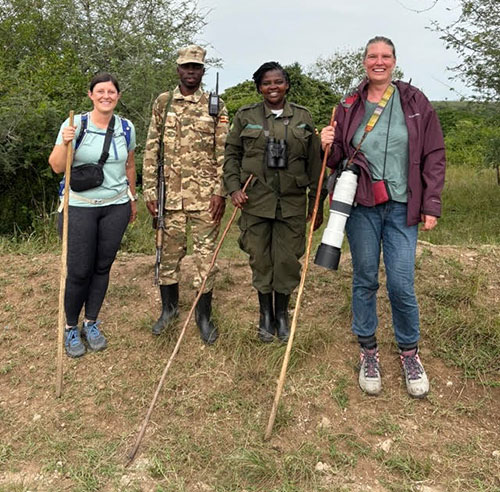
Pacific Associate Professor of Biology Bonnie Bolkan, far right, spent six months in Uganda helping researchers study DNA in water and blood samples for zoonotic diseases. Submitted photo.

Scientists know that the best-laid plans can change in an instant.

When Pacific University Associate Professor of Biology Bonnie Bolkan received a Fulbright scholarship to conduct research in Uganda, she planned to sequence and study DNA in lions. However, when she arrived at Queen Elizabeth National Park in July 2025, her work pivoted to a greater need — studying DNA in the park’s natural water sources to combat the spread of disease.

For six months, Bolkan worked with researchers in the remote park, located along Uganda’s western border with the Democratic Republic of Congo, collecting water samples, processing wildlife blood samples, and amplifying, or copying, the DNA for study. From those samples, the lab could identify the presence of zoonotic diseases, which can be transmitted from animals to humans.

The work is critical due to a rise in anthrax infections in both humans and animals in Uganda. A naturally occurring bacterial infection, anthrax has been identified by the Uganda National Institute of Public Health as a growing public health concern. The country experienced 39 human anthrax outbreaks between 2017 and 2024, resulting in over 1,100 cases of the disease and 35 deaths. Just one human case of anthrax is enough to be considered an outbreak.

While there are approved tests to determine whether a human has anthrax, Bolkan said, it’s not known how effective those tests are on wildlife. Part of her work was to try to determine that effectiveness.

“They were given a number of the kits, and I helped them run through some of the protocols to compare it to molecular genetic testing for anthrax,” said Bolkan, who received her PhD in genetics from Cornell University in 2011. “Can you do these things in the field? We set up the test to figure out how useful they really are with animals.”

Bolkan taught lab workers proper techniques of processing and analysis, and also explained the science behind the work, following much of the same process she teaches students in her molecular genetics lab at Pacific.

“I did a lot of lectures on different topics with whoever was in the lab,” she said. “We talked about the science behind what we’re doing and the reasoning behind the procedures we were doing, and then getting them some more hands-on learning.”

The U.S. State Department has invested in several scientific labs across Uganda to study and combat zoonotic diseases like anthrax, including the one at Queen Elizabeth National Park. With the park’s remote location, the lab allows scientists to conduct studies without having to travel eight hours to the capital city of Kampala.
Image
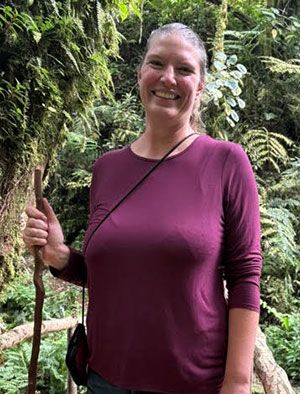
Bonnie Bolkan Standing On A Bridge And Holding A Hiking Stick
Text Box

"Right now, the biggest thing I see is having a lot of real-world examples to use to teach (Pacific students) certain concepts, and not just have it be the textbook example or a cartoon example."

— Bonnie Bolkan, on how her Fulbright experience benefits Pacific students

Body

Sampling water and sequencing DNA not only helps scientists study the spread of zoonotic diseases, Bolkan said, but also aids in studying microbial resistance in treating those diseases. Antibiotic overuse is also a concern in Uganda, with a 2021 National Institutes of Health study revealing that 74% of hospital patients in the country are on at least one antibiotic to treat a variety of illnesses. 

The more dependent people are upon antibiotics, the more resistant diseases can become to those treatments.

“In the U.S., (antibiotic overuse) mainly comes out of agricultural usage. There, it is human usage that is so high,” Bolkan said. “If you have a fever over 101 degrees, and it’s not malaria or typhoid, you take antibiotics. They have a much higher rate of antibiotic resistance than a lot of other areas, so monitoring it in natural waterways is becoming an effective way of monitoring.”

Work in Africa is more than a professional endeavor for Bolkan — it is highly personal. The Fulbright trip was her fifth time on the continent in the last 20 years. 

On her first trip, Bolkan experienced first-hand the importance of scientific and medical research there. Traveling with a church group to dig wells in Kenya, Bolkan contracted bird flu and spent most of the trip recovering in housing for U.S. government personnel. The only other people at the compound were researchers from the CDC and Walter Reed Medical Center conducting clinical trials on malaria in children.

Bolkan never got well enough to return to digging wells, so she tagged along with the researchers.

“I followed them around and got to visit the local hospitals and actually visit their labs to see where they were doing their clinical trials,” Bolkan said. “I learned what it’s like to run a clinical trial on children and why the U.S. government wanted to fund these projects. I don’t know that (the experience) changed my professional path, but it’s something I have always kept in mind.”

Bolkan is the latest Pacific faculty member to be accepted into the Fulbright Scholar Program, which funds short- and long-term overseas research and teaching opportunities for up to 800 U.S. scholars annually. Six Pacific faculty members have received Fulbright Scholar awards over the last 10 years.

Bolkan hopes that her Fulbright experience will benefit her Pacific students in tangible ways. She is seeking permission to import some of the water samples she took in Uganda so that her students can sequence them.

“They’ve learned all of those techniques and we can look at all of the different things that we can test for because of the DNA extractions,” Bolkan said. “We have all of the environmental DNA out of that water. And (our students) can look for different things and identify all sorts of species out there.”

If she can’t get the samples back, the experience still reinforces that the lessons and techniques that Bolkan’s students are doing have impact. They can save lives.

“Right now, the biggest thing I see is having a lot of real-world examples to use to teach certain concepts,” she said, “and not just have it be the textbook example or a cartoon example, but being able to contribute real-world examples.”

Publication Date