
Teaching To The Letter: Steele Continues To Enlighten

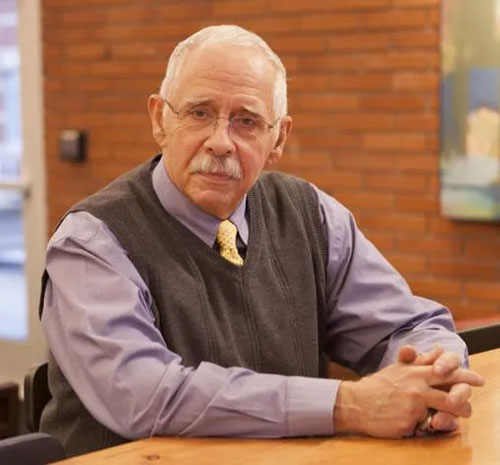
Mike Steele sits at a table. He has white hair and a white mustache and is wearing glasses. He is wearing a light blue dress shirt with a light yellow tie and a gray vest. His hands and folded in front of him.
Mike Steele Hon' 26, who received an honorary Doctor of Humane Letters degree from Pacific University in May 2026, has been teaching classes at the university for over 50 years.

Fifteen years after retiring from full-time teaching at Pacific University, Mike Steele Hon. ’26 is right back in the classroom this fall.

He can’t imagine being anywhere else.

“Why would you stop doing something you love?” said Steele, the Distinguished University Professor Emeritus of English who continues to teach at least one class per year. “I love working with students. I love staying in touch with the life of the mind. If you really love something, do you just stop it? No, you don’t.”

Whether teaching about Victorian poetry (what Steele earned his PhD in), the intersection of religion and the Holocaust, the nuances of sport, or any his many other interests, Steele still relishes stretching his own mind and those of his students, something that he has done at Pacific for over 50 years.

Steele’s excellence in education and passion for learning were honored by Pacific in May 2026 with an honorary Doctor of Humane Letters degree, adding to his long list of accolades for academic excellence.

“It was a surprise. I am very proud of the distinction,” Steele said.

While many faculty members focus on a specific specialty or two, Steele’s class offerings have historically been as varied as his interests: Holocaust Literature, the Literature of Unbelief, Native American Literature, Sociology of Sport, British Literature, and Disability Studies, to name a few.

Those interests stretched far beyond the classroom. He coached cross country and football. At times, he advised the Index student newspaper, the Heart of Oak yearbook and the Pacific Review literary magazine. He also served as the advisor for the Alpha Zeta fraternity.

Steele’s passion for the sport of handball led him to found Pacific’s handball team in 1977. He built the program into a national power over his 37 years as head coach, mentoring numerous state champions and All-Americans. He led the Boxers to team national championships in 2013 and 2014.

If that wasn’t enough, Steele has continued to write and publish on his vast academic interests. His vita includes at least 10 books he has authored or co-authored on subjects ranging from treatises on Holocaust studies to the definitive encyclopedia of the football program at his beloved University of Notre Dame.

Steele believes that if he had been anywhere but Pacific, his career would have been much more one-dimensional.

“They let me operate within my enthusiasms,” Steele said. “This is my kind of place.”

“We All Need Help”

For Steele, being a resource and support for students at Pacific is just as important as teaching. It was a lesson that he learned as an undergraduate at Notre Dame.

A first-generation college student, Steele faced financial struggles at the end of his junior year that put his ability to complete his degree in question. At the suggestion of his writing professor, Richard Sullivan, Steele wrote a letter to the university’s president, Father Theodore Hesburgh, explaining his situation and asking for help. 

Writing that letter — an ask for help — changed the course of Steele’s life. A few days later, he was summoned to Notre Dame’s financial aid office, where he was presented with a letter from Hesburgh with a simple directive: Do not let financial aid become a problem for this upcoming senior.

“I personally felt grateful ever since I saw that letter,” Steele recalled. “He didn’t really know me at the time. But wow, what a great way to handle something.”
Image
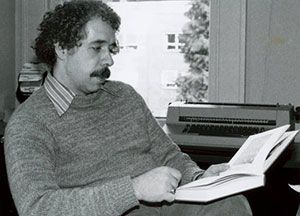
A photo of Mike Steele from 1983. He is sitting in a chair, reading a book.
Text Box

“We all need help: financial, medical, emotional. We are often reluctant to seek help. It’s a terrible mistake not to seek help.”

— Mike Steele Hon. 26

Body

Steele never forgot the gesture and has never hesitated to help students who reach out for assistance. Generations of Pacific students noticed, honoring Steele nine times with the Charles Trombley Award, recognizing professors who excel in teaching and demonstrate dedication to students outside of the classroom. 

In accepting his honorary doctorate, Steele reminded the Class of 2026 that asking for help is not weakness, but rather strength.

“I have noticed over the course of my career that it’s abundantly clear that we will encounter a variety of troubles,” Steele said. “We all need help: financial, medical, emotional. We are often reluctant to seek help. It’s a terrible mistake not to seek help.”

Personalized Attention
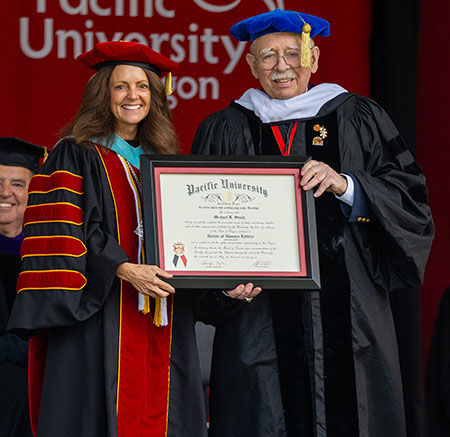
Mike Steele received his honorary Doctor of Humane Letters degree from Pacific President Jenny Coyle.
Mike Steele Hon. '26 receives his honorary Doctor of Humane Letters degree from Pacific President Jenny Coyle '90, OD '93, MS '00 at the May 2026 undergraduate commencement ceremony. Photo by Thomas Lal.

When Steele started at Pacific, he simply transferred over the structure of the courses he taught at Michigan State, where he earned his master’s and doctorate degrees. In 1974, over 43,000 students were enrolled at Michigan State, including over 8,900 graduate students. That same year, Pacific enrolled just over 1,000 students. 

What worked in East Lansing, where he taught 150 students in introductory-level classes, didn’t work in Forest Grove. His first student evaluations weren’t great.

As Steele adjusted to Pacific’s smaller class sizes and high rigor, the feedback greatly improved. In 1993, Steele received the university’s Distinguished University Professor award, recognizing longtime outstanding performance by a Pacific faculty member.

“This is a pretty good place to make some mistakes,” Steele said in gratitude for the opportunity to grow and learn at Pacific.

That growth resulted in some innovative learning experiences. Steele and Distinguished University Professor Emeritus of History Marsh Lee came together to team-teach courses in Holocaust studies. He later taught the same course with former professor Jack Boas, a Holocaust survivor. In 1994, Steele helped develop the university’s winter term service-learning course to the Navajo Nation, which was revived in 2024 after a 10-year hiatus.

Steele’s early experiences not only helped him learn to keep students at the front of his mind, but also allowed him to make education more personal, which he believes made him a better instructor.

“We’re just small enough, and part of our success is that we’re small,” he said. “You get personalized attention. I’m so glad that at Pacific, we are a family. That really sticks with me.”

Publication Date