Developing Great Optometrists, Better People

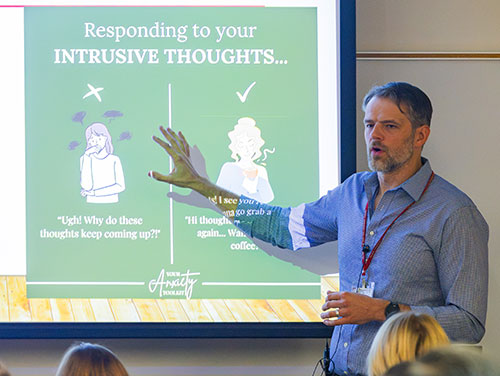
Professor Ryan Bulson in front of a PowerPoint slide on "Responding To Your Intrusive Thoughts"
Pacific Optometry Professor Ryan Bulson has developed a class designed to help College of Optometry students set themselves for success with the demands of graduate school, addressing study skills, mental health wellbeing and the dangers of too much screen time. Photo by Thomas Lal.

Pacific University Professor Ryan Bulson wants his optometry students to be much more than good doctors.

“I want them to be well-rounded people,” he said. “Of course, I want them to be good students, good optometrists and good clinicians. But I want them to be good, well-rounded, well-adjusted people.”

To help achieve that goal, Bulson has developed a course for first-year College of Optometry students designed to teach skills that will help make them both better graduate students and people.

“How To Thrive In Optometry School” is an eight-week class designed to arm students with the knowledge, strategies and skills for success as they transition from undergraduate work to the rigors of optometry school. The course focuses on study skills and techniques, the science of learning, and wellness techniques such as mindfulness exercises.

Required of all first-year students, Bulson believes it is the first core course of its kind at an optometry school in the U.S.

“Most schools incorporate these aspects of these skills into an orientation,” Bulson said. “It’s an eight-hour day, and they’ll have a couple of slides on active test-taking strategies or a couple of slides on anxiety. It’s unique that this is a dedicated course. 

“Pacific is going the extra mile by making a course of this nature part of the core curriculum to promote the academic success and well-being of our students.”

Meeting The Changing Needs Of Students

In recent years, particularly following the COVID-19 pandemic, Bulson and other professors have noticed increased anxiety in their students. 

They’re not alone. A 2023 study published in Brain and Behavior revealed that almost 35% of graduate students suffer from anxiety, up from 24% before the pandemic. Of those surveyed, 10% said they suffered from severe anxiety. Bulson said that statistic, and a marked increase in the need for student support services, drove his desire to teach the class.

“We have more students coming in for office hours,” he said. “We have more students needing accommodations for testing because they have testing anxiety. The students’ needs have changed.”

The class is another component in Pacific’s quest to support the emotional well-being of its entire community. Pacific is one of 38 institutions that received Insight Into Academia’s 2026 Excellence in Mental Health and Well-Being Award, recognizing universities providing innovative support for the emotional well-being for graduate and undergraduate students, faculty and staff alike.
Image
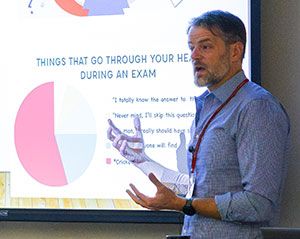
Ryan Bulson in front of PowerPoint slide on test anxiety.
Text Box

“How To Survive in Optometry School has been a fantastic reminder that nobody is perfect, but we are all capable. It has given me tangible, actionable tools to adjust my study habits early on. It is setting me up for success.”

— Katie Langer OD '30

Body

The first three weeks of the class focused on the science of learning, specifically on unlearning study skills that Bulson believes are ineffective for graduate students. He discussed the limited benefits of rereading educational texts, the Dunning-Kruger effect (where high performers underestimate their own skills), and aspects of motor learning important to study success.

The next two weeks were designed to address those anxieties, including lessons on the myth of multitasking and mindfulness exercises. The final three weeks honed in on the specific challenges facing Gen Z, the generation that includes almost all of this year’s first-year students. Topics of discussion included isolation, the mental health impacts of smartphone and social media use, and the effects of screen use on eye health.

For Katie Langer OD ’30, the research on the ineffectiveness of multitasking motivated her to make changes in how she manages time for her studies.

“It proved that my attempts at multitasking wasted more time than it saved,” Langer said. “It’s easy to fall into bad habits when I’m anxious or feel like I’m running out of time. In a program where time is such an asset, having that proof will motivate me to choose more effective strategies.”

Mercedes Mendoza ’26, OD ’30, found that the study techniques taught in the course, specifically active recall of study materials, are making her first year in optometry school easier.

“I am not good at switching between classes. I start mixing up information between classes, but active recall has been helpful,” Mendoza said. “There is a lot of information, but this helps me to tackle it.”

In fact, Bulson said he has received more positive feedback on “How To Thrive in Optometry School” than for just about any other course he has taught.

“I’ve never had students come up to me unsolicited after class and say, ‘Hey, thank you for presenting that. It really resonated with me,’” Bulson said. “I’ve had numerous students come and give me really positive feedback.”

Personal Experience, Future Feedback

“How To Thrive in Optometry School” was based, in part, on Bulson’s personal experience using mindfulness techniques, which began during the COVID-19 pandemic.

Bulson regularly uses grounding exercises to help manage the stress of being a faculty member, a husband and father. Notifications from the Calm app are one of the few that he allows on his smartphone.

The more that he practiced mindfulness, the more Bulson was convinced that his optometry students could benefit from the same techniques.

“I’ve seen the positive aspects in my life, and I try to convey that to students,” he said. “They are often coming in really high strung. They’re stressed out and burned out. So it’s a way for them to ground themselves and be more in the moment.”

In Spring 2026, Bulson took a sabbatical and fully immersed himself in studying the intersection between graduate studies and mental health, metacognition, learning styles and study skills. His research formed the framework for the class.

But that research is far from over. Bulson plans to continue researching graduate student wellness, including direct feedback from his own students. That includes information from a study-skills inventory taken at the beginning and end of this year’s class to determine which topics have the most positive impact.

Langer doesn’t need the data to know how much the class has helped her.

“How To Survive in Optometry School has been a fantastic reminder that nobody is perfect, but we are all capable,” she said. “It has given me tangible, actionable tools to adjust my study habits early on. It is setting me up for success.”

Publication Date