How do you teach teenagers to embrace the power of poetry? You convince them that it’s around them every day.
It’s the first lesson that Nancy Miller Gomez MFA ’17 teaches as part of Rising Voices, a poetry-writing program that she developed for high schools in and around Santa Cruz, California.
Gomez, a graduate of Pacific University’s Master of Fine Arts in Writing program, opens by asking students how many of them like poetry. Only a couple of hands go up. But then she plays a “Poetry vs. Rap” game, challenging students to distinguish whether a line is from a poem or a rap song.
“And as soon as I do that, there’s this little light bulb that goes off that says, ‘Oh, maybe I do like poetry. Shakespeare sounds like a rapper,’” Gomez said. “It’s a great way to knock poetry off its pedestal.”
Rising Voices is Gomez’s legacy program for her two-year term as Santa Cruz County’s poet laureate, which runs through January 2027. Now in its second year, Rising Voices provides instruction on writing and appreciating poetry to 14 high schools in conjunction with the Santa Cruz County Department of Education. In its first year, 360 students participated in the program.
Throughout her life, poetry has been a release for Gomez, helping her cope with life’s struggles. In Rising Voices, she hopes to provide that same healing power to youth.
“They are under a lot of insecurity and stress and anxiety,” she said. “I wanted to offer poetry as a way for kids to help them grapple with a lot of these big emotional things they’re going through.”
Poetry As An Outlet
After convincing teens that poetry is no different than their favorite rap lyrics, the next challenge is convincing them that they can write it. Gomez begins the eight-week program with an exercise in paying attention. She asks them to write, noticing what is around them. She encourages them to put on paper anything that comes to mind. Next comes the poems, where simply writing a list becomes a poem.
As students realize that there are few rules about writing poetry, the creative juices flow. Soon they’re competing to see who can write the best poem.
The classes are designed to be low-pressure (Gomez won’t refer to writing exercises as assignments), providing students space to express themselves through their poems, emphasizing self-expression over structure.
“Once they see that it’s not that difficult or intimidating, then they’re pretty good about opening up and starting to write,” Gomez said. “Once they start writing and sharing things with each other, they feel good about it. And once they get going, they don’t stop. They fill notebooks with poems.”
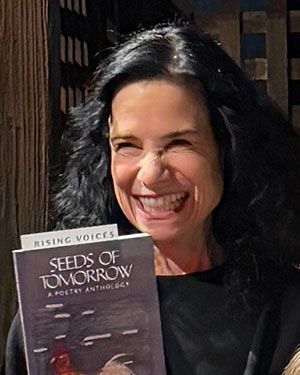
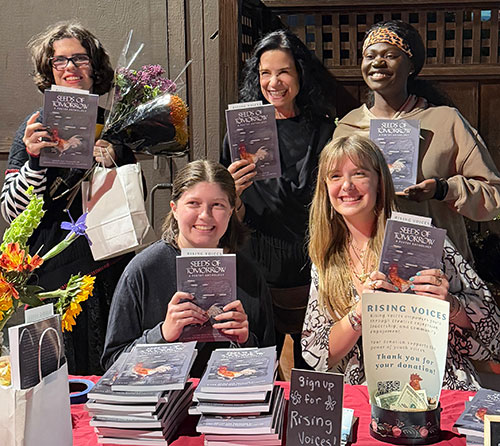
Concurrently, Gomez created the Youth Poetry Collective, a companion after-school program to Rising Voices that reaches additional students. The two programs combined in Spring 2026 to publish a poetry anthology, Seeds of Tomorrow, that was edited, produced and illustrated by the programs’ participants.