"It's Very Good To Be Judy Sherman"

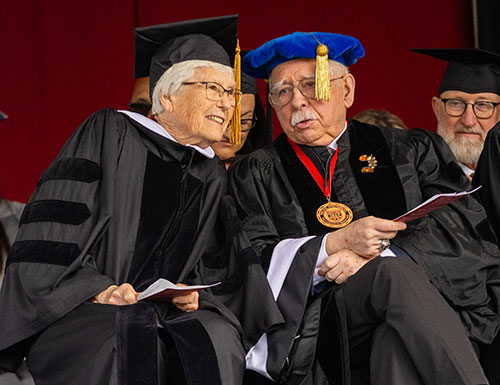
Judy Sherman Hon. '26 talking with Mike Steele Hon. '26
Judy Sherman Hon. '26 shares a moment with fellow honorary doctorate recipient Mike Steele Hon. '26 at Pacific's May Undergraduate Commencement ceremony. Sherman received an honorary Doctor of Humane Letters degree in recognition of over 50 years of service to the university. Photo by Thomas Lal.

Judy Sherman Hon. ’26 has a long list of accomplishments from her five-decade career at Pacific University.

“Do you want the whole list?” she asks before starting through a long list of the many players and coaches she has worked with over the years. Sherman calls them her top accomplishments because nothing else that she has achieved happens without them.

“That is my biggest success,” Sherman said. “The student-athletes are what put me where I am today, especially in softball. Their hard work, their dedication, the way that they worked together as a team, I could not have asked for more than that.”

Those student-athletes, and her many colleagues in the Boxer athletic department over the years, have given Sherman a long list of honors, including an honorary Doctor of Humane Letters degree that Pacific conferred in May 2026 at the university’s undergraduate commencement ceremony. The degree recognized Sherman’s 53 years of service to Pacific as a coach, professor and athletic administrator, including 11 years as athletic director.

“I never thought something like this would happen,” Sherman said of receiving the honorary degree. “I was ecstatic to be able to tell my siblings about it, and to think that a place that I’ve given my heart to would appreciate me in this way.”

While Sherman began her Pacific career in 1967, the university has been part of her entire life. She remembers future colleagues Dan French ’56, MS ’64 and Varina French ‘56 ’65 babysitting her. Sherman’s father, Ellerd Larkins, often hired Pacific students for summer jobs at the lumber mill he operated south of town. And the family was a regular attendee of Pacific football games and other athletic events.

Those influences whetted Sherman’s passion for sports, which Larkins actively encouraged. He built a softball field at what is now the Lincoln Park Athletic Complex so that his daughter and other women could play. Sherman joined her first traveling softball team at age 11. She has loved the game ever since.

“I was lucky that my dad was ahead of his time, that he wanted something for his daughter that was the same or equal to his sons,” Sherman said.

It was one of those Pacific friendships, with physical education instructor Jean Horner ’52, that resulted in her first coaching job — leading the Boxers’ women’s basketball team for the salary of $50 for the season.

In a short time, Sherman added volleyball, softball, field hockey and track and field to her coaching duties. Success quickly followed. Her basketball team won the first Women’s Conference of Independent Colleges championship in 1969. Her volleyball teams won titles in 1981 and 1982. 

However, it was in softball where Sherman experienced the most success. She amassed 418 wins and a .714 win percentage in 26 years as head coach (including four years as co-head coach with Schuppert). She led the Boxers to seven national tournament appearances, led by a third-place finish at the 1985 NAIA National Championship and a fifth-place finish at the 1981 AIAW National Championship. In six tournament appearances, the Boxers finished no worse than ninth in the 16-team bracket. Additionally, Pacific won six straight conference titles between 1980 and 1985.

Along the way, Sherman coached 11 All-Americans, six NAIA District II Players of the Year and 70 all-conference selections, all members of her list of accomplishments.
Image
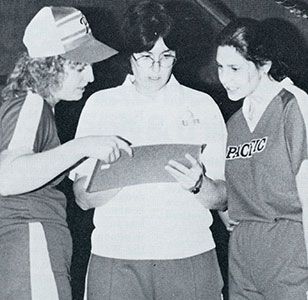
Judy Sherman in a white sweater and holding a clipboard. She is flanked on both sides by a  softball player.
Text Box

“I think Pacific was far beyond its time about the position of women and allowing women to participate. There’s only so much budget to go along, but I was lucky that they didn’t push us aside. They supported us.”

— Judy Sherman Hon. '26

Body
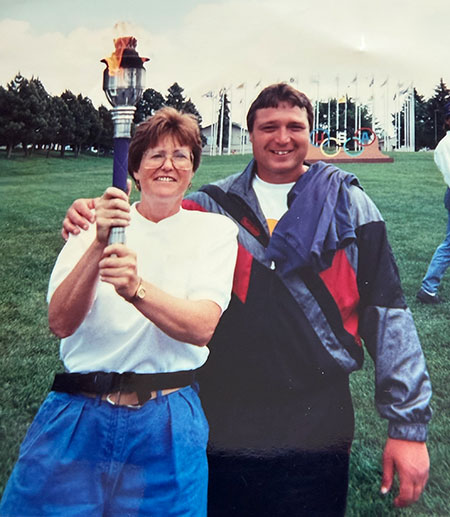
Judy Sherman holding the Olympic torch with a member of the torch relay.
Judy Sherman Hon. '26 holds the Olympic flame while visiting the U.S. Olympic Training Center in Colorado Springs, Colorado in 1996. Sherman's accolades in athletics include being a member of USA Softball's International Selection Committee, where she helped select the 2000, 2004 and 2008 U.S. Olympic softball teams. Submitted photo.

“Nothing breeds success like success, and we were lucky because we were one of the first teams to really have softball success,” Sherman said. “It made it easier for recruiting when players knew that they were coming to a place where we had some success. That helped.”

By the mid 1970s, Sherman was a full-time Pacific staff member, adding administrative duties within the athletic department and teaching physical education classes to her coaching duties. By 1980, Sherman oversaw all of Pacific’s women’s athletic programs. 

At a time when Title IX and the fight for equality in women’s sports could drive a wedge between male and female coaches, Sherman’s measured approach earned the respect of her male counterparts at Pacific. She believes that helped the university be more progressive in creating opportunities for women in athletics.

“I think Pacific was far beyond its time about the position of women and allowing women to participate,” Sherman said. “There’s only so much budget to go along, but I was lucky that they didn’t push us aside. They supported us.”

Sherman broke another barrier by being named Pacific’s director of athletics in 1993 at a time when just 4% of intercollegiate athletic directors were women. In her 11-year tenure, Sherman oversaw Pacific’s transition from NAIA to NCAA Division III membership, realized the addition of five varsity programs, including women’s wrestling, and spearheaded a $3 million renovation of the Stoller Center, the first since its construction in 1970.

That era of her career allowed Sherman the opportunity to influence softball at the national and international level. She sat on multiple NAIA and NCAA regional and national committees and served six years on the National Fastpitch Coaches Association’s (NFCA) Board of Directors.

For nine years, Sherman served on USA Softball’s Women’s Selection Committee, which identified, trained and selected the 2000, 2004 and 2008 gold-medal winning U.S. Olympic softball teams, and teams for other international competitions. The appointment allowed Sherman to travel the world with teams to Canada, China, Japan, and many other nations.

She served on the committee until the International Olympic Committee decertified softball as a medal sport following the 2008 Olympics. (Softball is being reinstated for the 2028 Games in Los Angeles.)

While Sherman points to her former student-athletes as her greatest accomplishments, there are plenty of others that cannot be ignored. She is a member of the Pacific Athletic Hall of Fame, the NAIA Hall of Fame (the first softball coach so honored) and the NFCA Hall of Fame. Pacific’s softball stadium is named in her honor. In 2012, she was the recipient of the DNA Award from the Oregon Sports Awards, honoring individuals for extraordinary passion and dedication to sports in Oregon.

Ultimately, though, it’s her people that top the list.

“I am so really proud of what we’ve been able to accomplish and the people that I’m still in contact with,” she said. “I feel very fortunate. It’s very good to be Judy Sherman.”

Publication Date