
Making Room For Students Across The Neurodiverse Spectrum

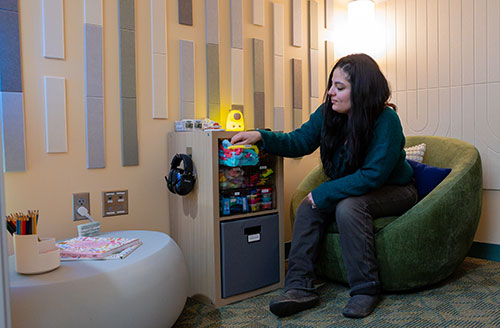
A student sits in a green chair and sorts through bins of fidgets in Pacific's sensory room.
Sasha Perez '29 sorts through the bins of fidgets available to users of the sensory room in Pacific University's Tran Library. The room, opened in February 2026, provides a space for autistic and neurodivergent students, faculty and staff to regulate their emotions. Photo by Thomas Lal.

Fire alarms are meant to protect life and property, but for Nicollet Young OT ’25, the alarms caused anxiety.

She remembers sitting in a graduate occupational therapy class at Pacific University’s Hillsboro Campus when the ear-piercing buzz and strobes signaled a fire drill. For Young, who is autistic and has attention-deficit/hyperactivity disorder, her mind and body couldn’t simply reset once the drill was over.

“I became so dysregulated that I could no longer engage in class,” said Young. “It ended up that I had nowhere to go to calm my body back down. I ended up lying in the backseat of my car for several hours before I was able to go home.”

Instead of amplifying her anxiety, the experience empowered Young to take action with a capstone project that will benefit Pacific students for years to come. To complete her Doctor of Occupational Therapy degree, Young researched sensory rooms and presented a detailed proposal to establish rooms on Pacific’s campuses. 

The sensory room in the Tran Library on the Forest Grove Campus opened in February. A second room, in the library on the Hillsboro Campus, opens in March.

Sensory rooms are designed to help individuals regulate their emotions and reduce anxiety through various tools, such as calming and adjustable lighting, tactile objects, and fidgets. The sensory room in the Tran Library includes a swivel chair, a weighted blanket, and a white-noise machine to block out outside noise.

While the sensory room project had its origins in Young’s personal experience, she quickly realized that she was not alone. She met other neurodivergent students at Pacific, who shared their experiences and concerns.

“There wasn’t a space for us to go to regulate our bodies so that we could re-engage in class and become the practitioners that we could be,” said Young. “I talked to other neurodivergent students and knew that this was something they wanted and were really excited about. So I focused on the advocacy to make that happen and make it a space that has the voices of neurodivergent students at the center to make sure that it meets their needs and feels like a safe space for them.”

Young’s research highlighted other examples of sensory rooms at eight colleges across the U.S. While some rooms were essentially enhanced study rooms, the most effective spaces, she said, provided space and tools to allow neurodivergent students to re-regulate and then return to activities.

Graham Turner, assistant director of student wellbeing with Pacific’s Student Counseling Center, said that Young’s project meets a need for a significant part of the Pacific community. The university’s 2023 Healthy Minds survey revealed that 30% of students identified as having a disability.

“These rooms help us have a broader conversation about what it means to have a disability, how we accommodate these things, what those practices look like, and creating a shared understanding so that folks with disabilities are not left to do all of their advocacy on their own,” Turner said.
Image
Sign For Sensory Room On Pacific University's Forest Grove Campus
Text Box

“I think it’s really important to have neurodivergent professionals, and that starts with education and making education accessible to everyone. So the fact that Pacific University took on this project, and didn’t just listen but put it into action, shows that they truly support this goal.”

— Nicollet Young OT '25

Body
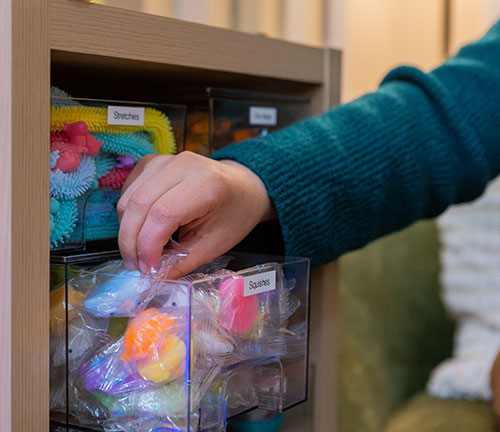
A hand reaches into a bin of squishable fidgets in Pacific's sensory room.
Items available to help individuals re-regulate in Pacific's sensory rooms include fidgets, lights, a weighted blanket, sour candies and more. Photo by Thomas Lal.

That broader conversation includes joining the College Autism Network’s Autism-Inclusive Campus Pilot Project. Pacific is one of seven schools in the U.S. participating in the two-year initiative, which challenges institutions to assess how they can enhance the college experience for autistic and neurodivergent students.

Young presented her sensory room proposal to university officials in Spring 2025, prior to Pacific joining the Autism-Inclusive Campus Pilot Project. The immediate reaction was not whether sensory rooms were a good idea, but how to find a way to make the rooms a reality. It reinforced for her how Pacific cares for its autistic and neurodivergent students and strives to make education accessible to everyone.

“I think it’s really important to have neurodivergent professionals, and that starts with education and making education accessible to everyone,” Young said. “So the fact that Pacific University took on this project, and didn’t just listen but put it into action, shows that they truly support this goal.”

Turner said that the fact that the sensory room proposal came from students, and in particular from a student project, made it easier to champion.

“I got really excited and was really grateful,” he said. “We try to be proactive. We try to anticipate what students need, what they’re looking for. We find that some of the most effective initiatives and services that we provide are the ones that students collaborate with us on, where we can say, ‘Yes, we’re going to meet you there. We’re going to follow through with this.’”

The sensory room project capped a successful three-year educational journey for Young at Pacific, preparing her for a career as a pediatric occupational therapist in Minnesota. She felt not only like Pacific met her where she was at, but gave her the tools to pass that care, passion and advocacy on to her young clients.

“Pacific recognized the person-centered approach of occupational therapy, utilizing occupational therapy frameworks, and teaching us tools to be that practitioner that can provide services that are valuable to our clients and not just what we see as valuable as practitioners,” Young said. “That is something that I really value.”

Publication Date