
An Opportunity To Set Groundbreaking Healthcare Policy

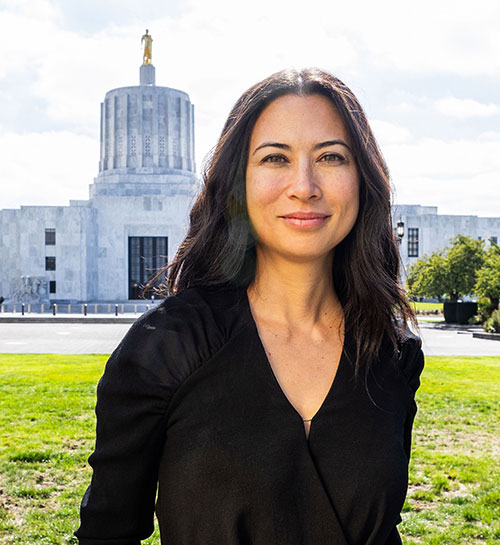
Rebecca Schoon Standing In Front Of The Oregon State Capital
Pacific Associate Professor of Public Health Rebecca Schoon begins her four-year term on the Oregon Universal Health Plan Governance in January 2027. Photo by Thomas Lal.

Pacific University Associate Professor of Public Health Rebecca Schoon has spent over a decade researching universal healthcare. Now, she has the chance to help develop the first program of its kind in the United States. 

Schoon has been appointed by Gov. Tina Kotek to Oregon’s Universal Health Plan Governance Board, charged with developing a universal healthcare system for the state. After her September 2026 confirmation by the Oregon State Senate, Schoon begins her four-year term in January 2027.

Helping develop such a system is a great opportunity for Schoon, who conducted her doctoral research at Oregon State University on Taiwan’s universal healthcare system.

“When I chose my doctoral dissertation research, it seemed like a really niche thing that we would never be able to apply in the United States,” Schoon said. “We think of universal healthcare as an abstract idea that is not possible. Now, in the last five or six years, Oregon has made specific and tangible progress toward becoming the first state to potentially enact universal healthcare.”

Schoon joins the board as it prepares to deliver the first draft of its plan to the Oregon Legislature. If approved, the plan could be referred to voters sometime in 2028.

While the appointment allows Schoon to be involved in increasing access to healthcare for thousands of Oregonians, it also allows her to demonstrate to her Pacific students that the passion of faculty members is not confined to the classroom.

“I think anytime students see real systematic change or policy change in action, it means a lot to them to be able to study it. It’s not just in a book or abstract,” Schoon said. “I think it is motivating and inspiring for students to see professors that are active in our communities and using the knowledge that we’ve built to contribute to those communities.”

Meeting A Voter Mandate

Schoon, a longtime advocate for universal healthcare, appreciates the commitment of Oregon voters, who passed a measure in 2022 that made “cost-effective, clinically appropriate and affordable healthcare” a right guaranteed in the Oregon Constitution.

The following year, the Oregon Legislature created the Universal Health Plan Governance Board to develop a universal healthcare system to meet that mandate. The board is charged with developing the plan’s framework, analyzing its economic impact, designing the administrative system, and providing avenues for public engagement.

The board’s nine members include five who bring expertise in healthcare delivery, finance or administration. The remaining four members represent community perspectives, and one member must have personal experience with barriers to care, ensuring that lived experience informs decisions.
Image
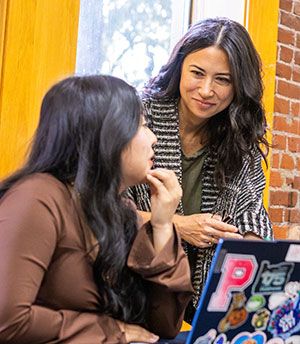
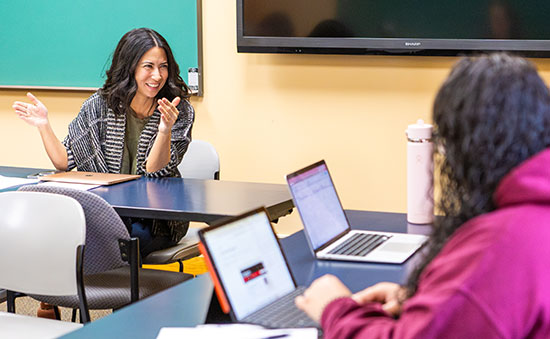
Rebecca Schoon In A Classroom Working With A Student
Text Box

“A topic like this is hard. It is complicated. It is difficult to understand all of the parts. It’s really a privilege to be able to have a role in helping translate complex knowledge that is going to impact people’s lives.”

— Rebecca Schoon

Body

Schoon plans to use her professional experience to guide the board on the most effective ways to secure public feedback on the proposal, both during the development stage and if it is referred to the ballot, and designing long-term plans for ongoing public engagement as the system is implemented.

“My expertise is in how you go beyond things that are recognizable, like focus groups and town halls, to methods that engage the public in real substantive decision-making. How do you engage the public in real substantive decision-making?” said Schoon, who also sits on the board of directors for the nonprofit Health Care for All Oregon. “I am really excited to help build a system where Oregonians can say, ‘This was built for us and our needs. And this is here to support my health and build my trust.’”

Public engagement will be critical in educating voters on the benefits of the proposed plan. According to a 2024 Gallup poll, 62% of U.S. adults believe it is the role of government to provide healthcare coverage, but opinions on a single-payer system or expanding current models, like the Affordable Care Act, remain mixed.

“We need to build infrastructure where Oregonians’ voices are part of determining what the system ends up looking like,” Schoon said.

Rebecca Schoon In A Classroom Working With A Student
Rebecca Schoon hopes that her service on the Oregon Universal Health Plan Governance Board will help provide real-world lessons that she can pass on to her public health students. Photo by Thomas Lal.
Fostering Discussion

While nearly 100 countries, including Canada, Mexico and most of Europe, have adopted some form of universal healthcare, the concept is a politically charged topic in the United States. Schoon does not shy away from that fact in her public health classes.

When teaching about universal healthcare, she makes it clear that she does not expect students to support the concept, but to understand the rationale for it and the trade-offs in both a universal healthcare system and the current system in the U.S. In doing so, Schoon hopes to foster a spirit of civil discourse and a desire to learn.

“Students are desperate, I believe, to better understand how to unlock the kind of political impasse that we see a lot in our nation right now,” Schoon said. “How do we talk about important issues in ways that don’t just lock people into their preexisting corners? I try to use my classes to build those skills as well. The class is on universal healthcare, but we don’t shy away from people’s fears and questions around it.”

To that end, Schoon asks students to consider others’ opinions and questions alongside their own. In one of the first assignments in her Universal Healthcare class, she asks students to interview people about their understanding, opinions and fears about universal healthcare.

Schoon believes that it is important to understand divergent opinions and discuss them openly in the classroom, where perspectives can be different than what students see on social media or hear at the dinner table at home.

“To have a space where you can look at the evidence, look at data, ask questions, and turn things over from all sides, I think that’s important for students to experience, and even for me to experience,” she said.

Along with discussions about universal healthcare, Schoon believes her class provides tangible real-world knowledge for students who have never navigated the complex U.S. healthcare system. Many don’t understand how co-pays or deductibles work, or why a pre-authorization is needed for some services.

The more knowledge that Schoon can provide her students, the more prepared they will be to navigate the healthcare system — or perhaps change it.

“A topic like this is hard. It is complicated. It is difficult to understand all of the parts,” Schoon said. “It’s really a privilege to be able to have a role in helping translate complex knowledge that is going to impact people’s lives.”

Publication Date