
Accelerated Chemistry Degree
Earn your bachelor's at Oregon's first in-person, three-year chemistry degree program. With the three-year bachelor’s in chemistry at Pacific, you’re ready to start your chemistry career one year sooner.
Three-Year Chemistry Curriculum
You can earn a three-year degree in chemistry by reducing general education electives. While four-year students take a total of 124 credits for their bachelor’s, three-year students take 96 credits.
The accelerated chemistry degree consists of 46 major credits to be taken over a three-year course schedule. Like the four-year chemistry degree, the three-year chemistry degree includes the same series of chemistry core courses and also requires a capstone project. The major requirements for the three- and four-year chemistry degrees are the same, but three-year students follow a focused schedule so they can complete these major requirements through three years of intensive study.
Due to the focused, intensive course schedule, three-year chemistry students must arrive at Pacific pre-calculus ready. The four-year chemistry degree is a better choice for students who are not ready for pre-calculus in the fall semester of their first year.
A Degree Focused on Experiential Learning
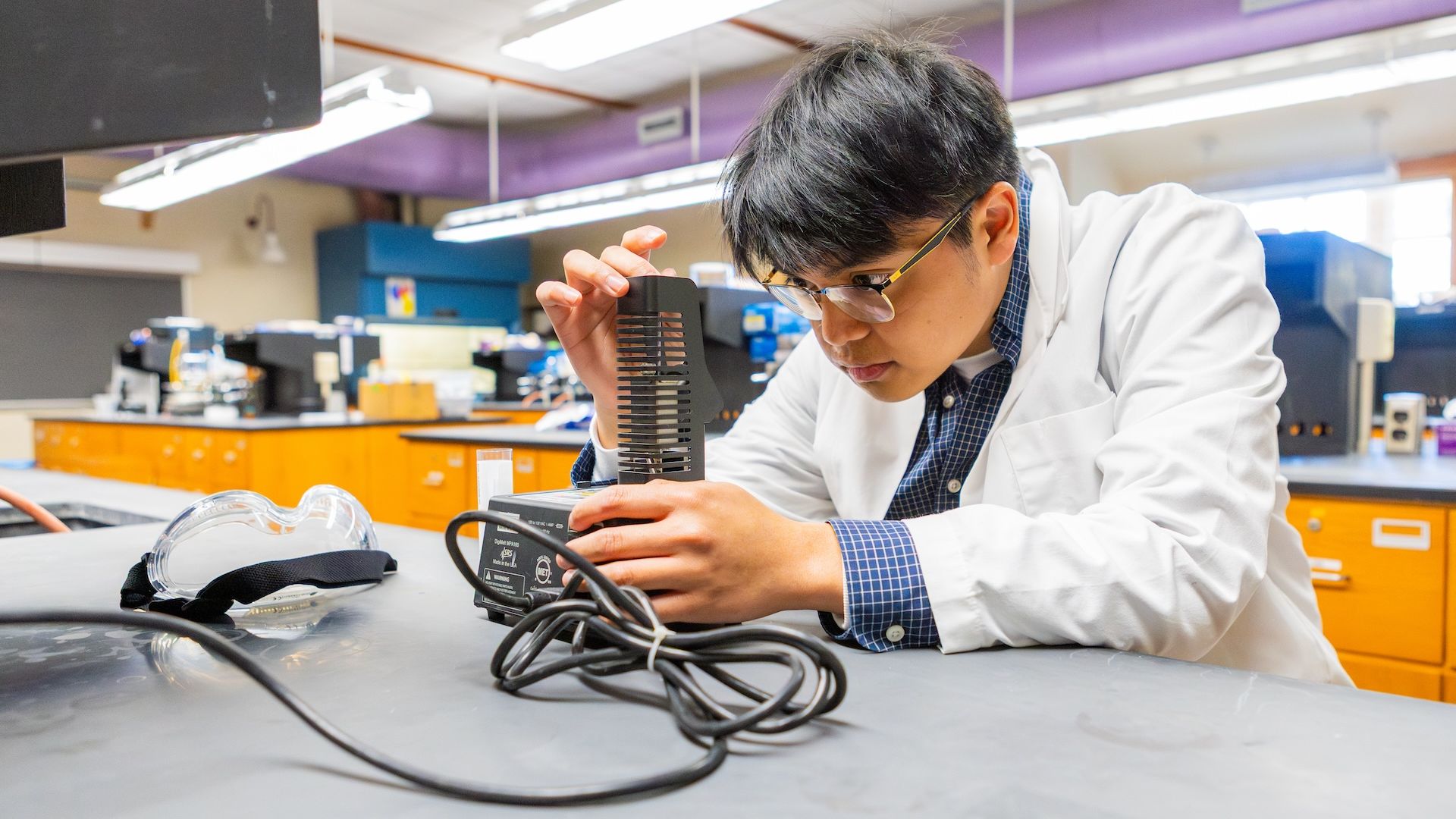
The three-year chemistry degree at Pacific University contains the same amount of laboratory work as the four-year degree program. With the same number of lab hours, this means that you get an intensive lab experience. Students in the three-year degree program can also gain additional hands-on experience through summer internships and their capstone project research.
Chemistry Core Courses
- Chem 220-230 General Chemistry I-II , 8 credits
- Chem 300 or 303 and 400 1 year of Organic Chemistry, 8 credits
- Chem 333 Introduction to Inorganic Chemistry, 2 credits
- Chem 340-341 Quantitative Analysis, 4 credits
- Chem 370 Fundamentals of Physical Chemistry, 4 credits
- Chem 385 Chemistry Seminar, 1 credit
- Chem 396 Chemical Literacy, 1 credit
- Upper Division Chemistry Elective(s), 4 credits
- Chem 486 Capstone Research, 1 credit
- Chem 489 Capstone Project,1 credit
- Math 226-227 Calculus I-II, 8 credits
- Physics - one semester with laboratory (Phy 232 recommended), 4 credits
In order to complete all chemistry degree requirements within the three-year schedule, students should work closely with their advisor to follow the required course sequence and make sure they are able to take all core courses. There is limited flexibility in the courses and sequence.
Three-Year Chemistry Example Schedule
- First Year
-
Fall Semester
General Chemistry I
Mathematics (Pre-Calculus)
First Year Communities
First Year Advising
Language Requirement -
Winter Term
Core Requirement
-
Spring Semester
General Chemistry II
Mathematics (Calculus I)
Elective (Bio)
Language Requirement
-
- Second Year
-
Fall Semester
Physics I
Fundamentals of Organic Chemistry / Survey
Chemistry Seminar
Elective
Mathematics (Calculus II) -
Winter Term
Introduction to Inorganic Chemistry
-
Spring Semester
Elective
Advanced Organic Chemistry
Chemical Literacy
Elective
Core Requirement
-
- Third Year
-
Fall Semester
Capstone Research
Quantitative Analysis
Elective
Core Requirement
Core Requirement -
Winter Term
Core Requirement
-
Spring Semester
PChem
Chemistry Elective
Capstone
Core Requirement
Core Requirement
-
Three-Year Chemistry Careers
A three-year chemistry degree qualifies graduates for a variety of jobs that they can begin immediately upon graduation, including:
- Chemical technician (industry, biotech, medical, research)
- Chemical and scientific instrument sales
- Environmental testing and monitoring
- Quality control chemist (manufacturing, food, pharmaceuticals)
- Pharmaceutical research or manufacturing
Choose Between Three- & Four-Year Programs
Debating between the three-year and four-year chemistry degrees at Pacific? At Pacific, each student works closely with their academic advisor to ensure that their degree — whether it is three-year or four-year — is aligned with their purpose and goals for the future. Here are some of the main questions to consider and to discuss with your advisor as you make your choice.
Need to get out into the workforce as fast as possible? Choose the three-year degree.
The three-year chemistry degree allows you to graduate with your bachelor’s degree one year sooner so you can get into the workforce faster.
Want to get your bachelor’s degree but can’t afford four full years of college? Choose the three-year degree.
The three-year degree saves you a full year on tuition and other college expenses while giving you the full campus college experience, including access to on-campus housing, student activities, and the same financial aid opportunities as four-year students.
Want to study abroad or double major? Choose the four-year degree.
Although technically possible, studying abroad or adding a second major may be difficult because of the focused, intensive chemistry course sequence required to complete your degree in three years.
Interested in graduate school? Check with your advisor and the graduate school you would like to attend.
Some schools might prefer the four-year degree, though some will accept the three-year degree.
Though the three-year degree will be acceptable in many of Pacific’s graduate programs — and some fields, like pharmacy, do not require a bachelor’s degree — the course schedule for three-year chemistry students doesn’t include enough electives to fulfill the prerequisites that many graduate programs require. Three-year degree chemistry students can change their minds and easily switch to the four-year degree program.
Learn more about the differences between Pacific's four- and three-year degrees.