
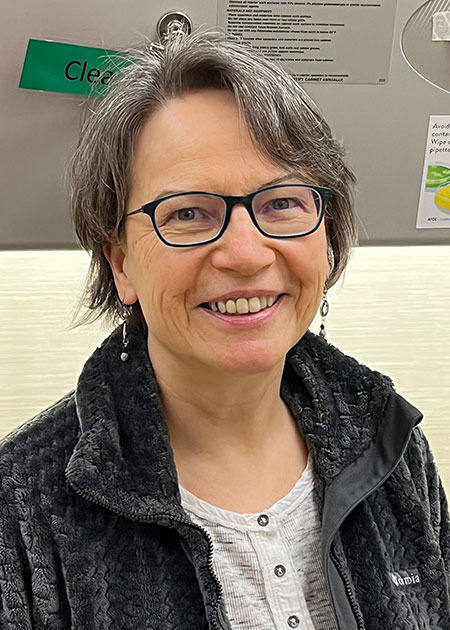
Sigrid Roberts, a professor in Pacific University’s School of Pharmacy, has received a $464,000 National Institutes of Health grant to continue research into potential treatments of a neglected tropical disease.
The Academic Research Enhancement Award, from the NIH National Institute of Allergy and Infectious Diseases, provides funding for Roberts’ research project, “Ornithine Decarboxylase as a Therapeutic Target in Leishmania: From Mechanism to Application,” through July 2029.
The study is investigating potential treatment strategies for leishmaniasis, a parasitic disease spread by bites from infected sand flies that can be fatal if left untreated.
According to the Centers for Disease Control & Prevention, leishmaniasis occurs in parts of 90 countries, including the U.S., and is usually found in tropical or subtropical climates. The World Health Organization estimates that as many as 1 million new leishmaniasis cases occur annually, mostly in Africa and South America where access to treatment is limited for many populations.
“We are thrilled to receive this award. It builds on our previous work characterizing and validating the polyamine pathway as a potential therapeutic target,” Roberts said. “Research on leishmaniasis is especially important because it disproportionately affects communities and countries with limited resources for research and treatment development. Although the disease is not widely known, it affects millions of people each year and remains a major global health challenge. We hope our work can contribute to developing better treatments for those who need them most.”
Symptoms of leishmaniasis vary widely depending on the form of disease and can include skin lesions and ulcers, enlargement of the spleen and liver, and partial destruction of the mucous membranes of the nose, mouth, and throat.
Roberts said that current drug treatments for leishmaniasis have significant limitations, including the potential for severe side effects, the need for clinical administration for most therapies, and the growing threat of drug resistance. She is hopeful that this study can lead to the development of safer, more affordable drugs that can lead to more widespread treatment and slow the growing threat of drug resistance, especially in impoverished areas of the world.
Specifically, Roberts and her team are working to understand what makes Leishmania parasites able to grow and persist, with a particular focus on polyamines, small molecules that the parasites need to survive.
They are studying the role of polyamines and the enzyme ornithine decarboxylase (ODC), a key component of the parasite’s polyamine-producing pathway. Building on these findings, the team will evaluate whether DFMO, an FDA-approved drug that inhibits ODC, can be combined with existing anti-leishmanial drugs to improve treatment efficacy and potentially overcome drug resistance.
“While the journey from basic research to clinical application is a long one, our work could pave the way for developing new drugs that target the polyamine pathway, ultimately helping to cure patients of this deadly disease,” Roberts said.
Roberts’ research team includes co-investigators and fellow pharmacy professors Nicola Carter and Michael Espritu, along with Jon Taylor, a senior research assistant in the School of Pharmacy. Additionally, more than 24 undergraduate and graduate students have worked on the project over the last five years.
This is the second NIH grant that Roberts has received for the leishmania research project. She received her initial $376,000 Academic Research Enhancement Award in 2020.
Research is a significant cornerstone of the Pacific educational experience. In 2025, Pacific was designated as a Research College & University by the Carnegie Foundation for the Advancement of Teaching, recognizing colleges and universities with an annual spending of at least $2.5 million in research and development.
The top private research university in the Pacific Northwest, Pacific currently manages a portfolio of $7.7 million in external funding for research activities. During the 2024-25 academic year, the university expended $3.1 million from the federal government.
A significant focus of the university’s research focuses in healthcare — Pacific is the largest private preparer of healthcare professionals in Oregon. Other current studies in healthcare include work by pharmacy professor Fawzy Elbarbry to identify naturally occurring substances that could reduce inflammation in heart patients, and by graduate psychology assistant professor Cynthia Brown to use multisystemic therapy to treat teens involved in the juvenile justice system.