From Book Learning To Lab Exploration

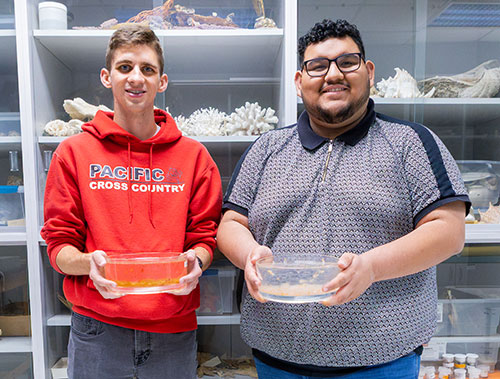
Two students hold large petrie dishes filled with microscopic sea anemone. The student on the left has shoter brown hair and is wearing a red hooded sweatshirt that reads Pacific Cross Country. The student on the right has dark short hair and a beard, is wearing black-framed glasses, and is wearing a gray and black collared shirt.
Kyle Woodcock '27, left, and Ramiro Perez-Guillen '27 hold a pair of large Petri dishes full of sea anemones that they raised in Pacific's Strain Science Center. Woodcock and Perez-Guillen worked with Biology Professor Katrina Gundlach on a summer research project on how defense mechanisms in anemones and other cnidarians are affected by climate change. Photo by Thomas Lal.

At a time when global challenges demand immediate innovation, 29 Pacific University undergraduate students spent their summer in laboratories and research spaces tackling some of the world’s most pressing issues — from modeling novel materials for atmospheric carbon capture to studying the neurological impacts of climate change on marine life.

Pacific’s Summer Undergraduate Research Program bridges classroom theory with real-world application. As the top-ranked private research university in the Pacific Northwest and a Carnegie-designated Research College & University, Pacific leverages these paid summer opportunities to develop career-ready students while advancing solutions that directly strengthen local and global communities.

Tackling Pressing Issues

Rather than taking seasonal jobs, chemistry majors Cai Woolsey ’29 and Leo Bala ’27 spent 10 weeks in Pacific’s Strain Science Center, writing code with Professor Kevin E. Johnson on his ongoing research project building computer models to show how metal-organic framework materials can better capture carbon dioxide.

“It sounded like a lot of fun,” said Woolsey. “I didn’t want to just go back home and exist over the summer. This is a job, but I also felt like I wanted to learn more. So when Dr. Johnson offered the opportunity to work with him for the summer, I jumped at it.”

One floor above, biology majors Kyle Woodcock ’27 and Ramiro Perez-Guillen ’27 spent the summer peering through microscopes, examining sea anemones that they raised just down the hall. Working with Professor Katrina Gundlach, they researched how the primary natural defense of the anemone, a type of stinging cell, is affected by bleaching brought on by climate change.

“These cnidarians were one of the first creatures to evolve and develop neurons. And the nematocysts we are studying are actually a slightly varied version of neurons, sending out chemical signals,” said Perez-Guillen, who plans to pursue neurology and research neurological disorders in older adults. “I think understanding how it all started is a good way to understand our more advanced human brains.”

A Legacy of Discovery

Pacific’s investment in undergraduate research reflects its broader institutional trajectory. During the 1990s, Pacific undergraduate faculty received 13 research awards totaling over $642,000. During the 2025-26 academic year, the university managed $4.6 million in externally sponsored projects within the Division & College of Undergraduate Studies — representing 27% of the university’s total $17 million of externally sponsored projects.

This trajectory earned Pacific designation in 2025 as a Research College & University by the Carnegie Foundation for the Advancement of Teaching. Additionally, the National Science Foundation has ranked Pacific as the top private research university in the Pacific Northwest each of the last six years.
Image
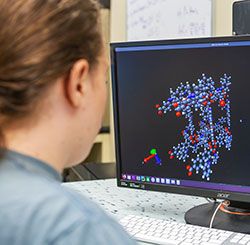
A feamle student looks at a computer screen with a model of a molecule of a metal-organic framework. You see the back of the student's head and her right ear.
Text Box

“I think one of the motivations to do research is not just the outcome of the research itself, but it is the human potential that we’re promoting. We’re preparing people to go out and be someone who makes a contribution in whatever field they graduate in.”

— Professor Kevin E. Johnson

Body
Philanthropic Support
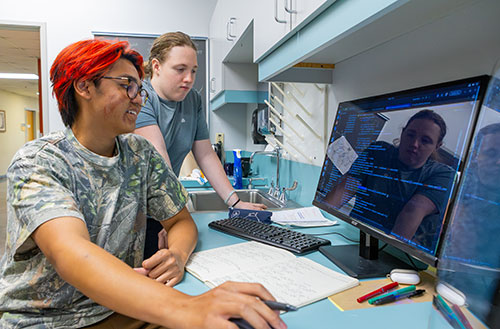
Two students review computer code or a large computer screen. The male student has dyed red hair, wear glasses and is wearing a camouflaged shirt. He holds a pen in his right hand, which hovers over the computer mouse. The female student has sandy brown hair pulled back into a bun and is wearing a slate blue shirt.
Leo Bala '27, left, and Cai Woolsey '29 study computer code to create new variations to model moving carbon dioxide molecules through metal-organic frameworks. Bala is pursuing the project, with Chemistry Professor Kevin E. Johnson, as his senior capstone. Photo by Thomas Lal.

The M.J. Murdock Memorial Trust is a prime contributor to student research opportunities at Pacific. Founded in 1975 as a legacy of Tektronix founder Jack Murdock, the trust has provided more than $1.5 billion in grants to nonprofits over the past half century, including more than $4 million to Pacific University.

Most recently, both Johnson and Gundlach received Murdock Trust grants to support their projects and employ student researchers as part of the Summer Undergraduate Research Program. By offering paid research roles, Pacific allows students from all backgrounds to gain high-level skills without having to choose between earned income and academic pursuits.

“We believe it is an essential element of our educational mission to provide motivated students with opportunities to work during the summer on something relevant to their educational goal, and funding is essential,” Johnson said. “I’m enormously grateful to the Murdock Trust for all of the support they’ve given to Pacific and to all of the colleges in the Pacific Northwest. It’s been a lifeline for many of us.”

Additionally, Pacific provides institutional funding for undergraduate research through several endowments, including the J & E Meyer/Arendt Arts & Sciences Research Endowment, the Bump Endowed Research Fund, the Kohler Endowment for Undergraduate Research, and the Templeton Undergraduate Research Endowment.

Driving Professional Skills

While historically rooted in the natural sciences, the Pacific Summer Undergraduate Research Program has expanded across Pacific’s undergraduate curriculum. Summer 2026 projects spanned music, psychology, journalism, sociology, history, literature, and public health.

Participating students will present their findings at the university’s Undergraduate Research Conference in October, and some, like Bala, will convert their summer experiences into their senior capstone projects. And, they’ll have the research experience that helps them transition to graduate-level study or directly into research fields.

“The biggest benefit, I think, is really providing experience. What does it mean to be professional in my field? How do I create and discover knowledge? What does that work look like? How do we deal with the setbacks, frustrations, and all of the pieces of being a professional in that field?” Johnson said. “I think one of the motivations to do research is not just the outcome of the research itself, but it is the human potential that we’re promoting. We’re preparing people to go out and be someone who makes a contribution in whatever field they graduate in.”

The development of professional skills works both ways. Gundlach believes that focused research work in the Summer Undergraduate Research Program makes her both a better teacher and researcher.

“I like the perspectives of young students,” Gundlach said. “I can guide us, but we’re a team. Let’s figure this out. I think the personal relationships that you can build in a small group add value, making me a better mentor and scientist.”

Publication Date